

WiFi development board with ESP-8266EX microcontroller, Arduino IDE compatible for OTA wireless uploads, includes onboard 5V 1A switching power supply with 11 I/O pins and 1 ADC pin, in a black PCB format.


WiFi development board with ESP-8266EX microcontroller, Arduino IDE compatible for OTA wireless uploads, includes onboard 5V 1A switching power supply with 11 I/O pins and 1 ADC pin, in a black PCB format.
Arduino-Compatible WiFi Development Board with ESP-8266EX and OTA Updates
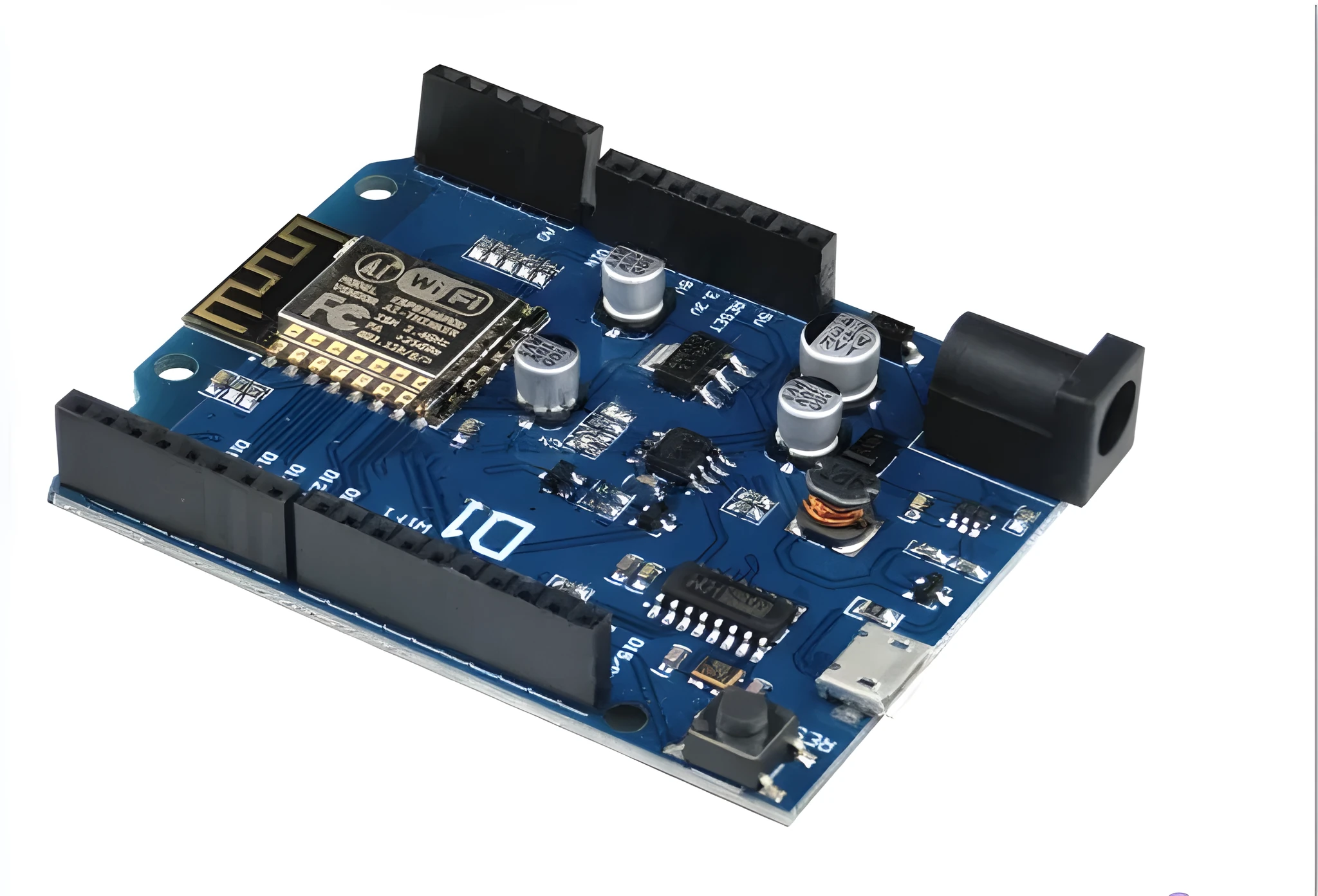
This development board centres on the popular ESP-8266EX microcontroller, providing a robust foundation for adding WiFi capability to electronic prototypes and IoT devices. Its primary advantage is seamless integration with the Arduino development environment. After a straightforward installation of the relevant hardware package, you can program it using the familiar Arduino IDE, with its operation mirroring that of a standard Arduino UNO. This drastically lowers the learning curve for makers and engineers transitioning to wireless projects. The inclusion of an onboard switching power supply further streamlines the build process by reducing external component count.
Features and Construction

The board is designed for practicality, bundling key features that address common hurdles in wireless development. Its construction is based on a standard printed circuit board (PCB) populated with the necessary integrated circuits and passive components to deliver the stated functionality.
Material and Build
The core platform is a professionally manufactured PCB that hosts the ESP-8266EX WiFi system-on-chip. This chip handles the 802.11 b/g/n wireless protocols. The board also incorporates the components for a switching mode power supply, which efficiently converts a higher input voltage down to a stable 5V output. The overall assembly is presented in a standard black solder mask finish common for electronic development boards.
Size and Practical Fit
While exact dimensions are not specified, the board's layout with 11 I/O pins and a power supply suggests a compact form factor suitable for breadboard prototyping or enclosure integration. The pin headers are typically arranged for easy connection to sensors, actuators, and other peripherals. The ADC pin's defined 0-3.3V input range is crucial for correctly interfacing with analogue sensors without requiring external level shifting in many cases.
Uses and Placement
This board serves as a versatile tool for a wide spectrum of applications, from hobbyist creations to professional proof-of-concept designs. Its value lies in combining wireless communication with a user-friendly development ecosystem.
Event or Professional Use
In professional or educational settings, this board is ideal for rapidly prototyping IoT devices, smart home sensors, or wireless data loggers. The OTA update capability is particularly valuable for deployed devices, as it allows for firmware patches or feature additions without physical retrieval. This can significantly reduce maintenance overhead in field applications, from environmental monitoring stations to interactive display units.
Everyday Home Use
For makers and hobbyists, it enables projects like WiFi-connected weather stations, smart garden controllers, or custom home automation nodes. The Arduino compatibility means a vast library of existing code examples and community support can be leveraged directly. The built-in 5V power supply simplifies powering the board itself and can often provide enough current to also drive small external components like LEDs or sensors, making initial project setup quicker.
Benefits and Buying Value
The board's design focuses on reducing complexity and external dependencies, which translates into tangible benefits during the development cycle and in the final application.
Reuse and Low Maintenance
The hardware is designed for repeated use across multiple projects. The robust PCB construction can withstand typical prototyping handling. The OTA feature directly contributes to lower long-term maintenance, as devices can be updated remotely. The power supply's wide input range (up to 24V) offers flexibility in choosing power sources, from USB adapters to larger DC supplies, enhancing the board's reusability in different scenarios.
Why Choose This Product
Choosing this board is a practical decision for anyone needing a validated, community-supported path to WiFi-enabled projects. It consolidates several key elements—the ESP-8266EX chip, Arduino IDE support, OTA, and an integrated power regulator—into a single, tested unit. This integration saves time compared to sourcing and wiring these components separately. It provides a reliable foundation where the core wireless functionality is assured, allowing you to focus development effort on your specific application code and hardware interfaces.